
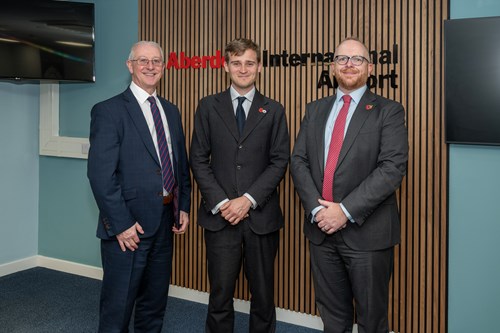
Aberdeen International Airport has secured approval from the Civil Aviation Authority (CAA) for its Airspace Change Proposal (ACP), with the milestone marked during a visit by the Aviation Minister Keir Mather to the airport.
The decision is a major milestone for the airport and completes Stage 5 of the UK's CAP1616 airspace change process. It enables Aberdeen International Airport to move forward with a series of approved changes designed to support the wider modernisation of UK airspace through the introduction of satellite-based navigation technology.
Over the past six years, the airport has worked closely with airspace users, industry stakeholders, communities and regulators to develop and refine its proposal.
Stakeholder feedback has helped shape the final design approved by the CAA.
Robert Paterson, Operations Director at Aberdeen International Airport, said: "Securing approval from the CAA is a significant milestone for Aberdeen International Airport and marks the culmination of almost six years of technical development, assessment and engagement."
"We would like to thank everyone who has contributed their time, feedback and expertise throughout the process. Their input has helped inform the final design and has played an important role in helping us reach this point."
"The approved procedures will provide additional operational resilience and support airline training requirements while maintaining our existing departure procedures and helicopter route structure. With approval now in place, our focus turns to preparing for implementation later this year."

During the visit, the Minister toured the CHC Helicopter facilities at the Airport and met with staff to hear what the changes will mean in practice for helicopter operations supporting the UK’s offshore energy sector, and to discuss the wider economic contribution of helicopter services.
Neil Gilchrist, Chief Financial Officer, CHC Helicopter, said: “Helicopter services from Aberdeen play a vital role in supporting the UK’s domestic energy production, sustaining highly skilled jobs and driving significant investment across the UK supply chain. The resilience of those services is nationally important.
“Anyone operating from Aberdeen knows the impact poor weather can have on scheduled flights. The ACP approval will give us greater flexibility in those conditions, helping more flights return safely to Aberdeen that might previously have been delayed or cancelled. That’s good for our customers and, importantly, for offshore workers wanting to get home to their loved ones as planned.”
Aberdeen International Airport is the first AGS airport to secure approval under the CAP1616 process, marking an important milestone not only for the airport but also for wider airspace modernisation efforts across Scotland.
The approval comes as Scotland continues to play a leading role in the UK's airspace modernisation programme. Glasgow Airport, also part of AGS, is working alongside Edinburgh Airport and NATS on the Scottish Terminal Manoeuvring Area (ScTMA) programme, which aims to modernise airspace across central Scotland.
The wider Scottish programme is expected to deliver around £130 million in benefits over the next decade through shorter flight paths, reduced emissions, improved operational efficiency and noise benefits for communities.
The Aviation Minister's visit also provided an opportunity to discuss the role of airspace modernisation in delivering a more efficient, resilient and sustainable aviation sector, as well as the progress being made across Scotland to modernise airspace and support future growth.
The approved proposal includes the introduction of new satellite-based arrival procedures, providing additional operational resilience when existing navigation aids are unavailable and supporting airline training requirements. It also releases a small section of controlled airspace that is not routinely required for aircraft arriving at or departing from Aberdeen, making it available for use by other airspace users.
We expect this proposal to result in little noticeable change to what you would normally experience from airport operations, and the approved changes do not affect departure procedures or Aberdeen's helicopter route structure.

Keir Mather, Minister for Aviation, Maritime and Logistics, said: “It was great to visit Aberdeen Airport and see the major progress being made in modernising Scotland’s airspace. This work is supporting more reliable, more direct flights for passengers, sustainable offshore operations, greater connectivity and stronger economic growth.
“We're overhauling some of the UK's busiest highways in the sky to pave the way for greener and quieter aircraft of the future.”
The approved changes are not yet operational. Aberdeen International Airport will now complete the necessary technical and operational preparations ahead of implementation, with the new approaches expected to be available for airlines to use from 26 November 2026.
Following implementation, the airport will enter Stage 7 of the CAP1616 process and undertake a formal Post Implementation Review. During the first year of operation, data will be gathered to assess whether the change is performing as intended before the CAA seeks feedback and determines whether the change should be confirmed on a permanent basis.